インタビュー 松本良多 | Made in Mind マガジン 2015
>100 Views
November 27, 23
スライド概要
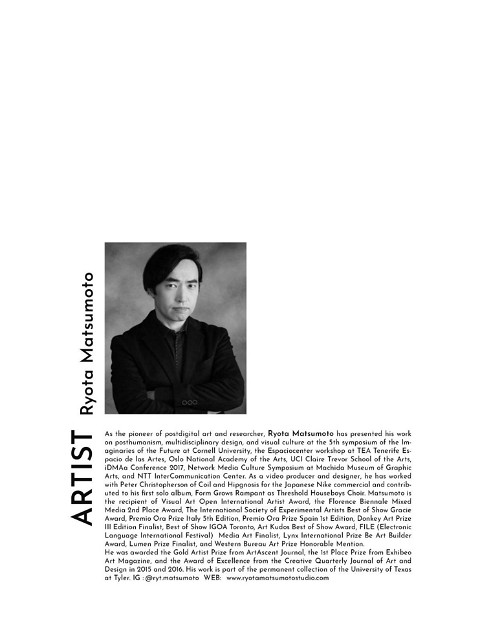
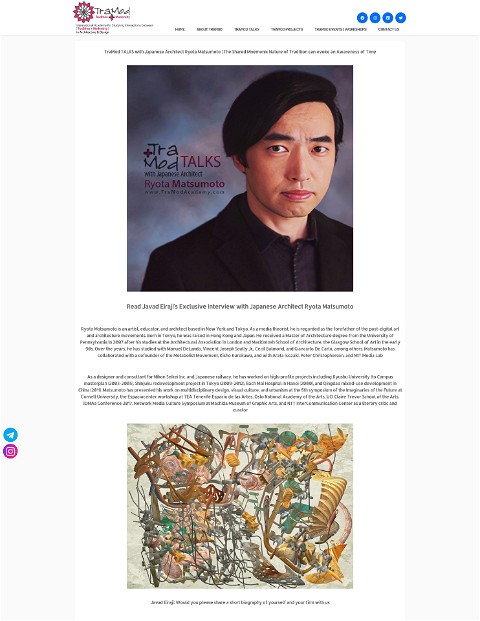
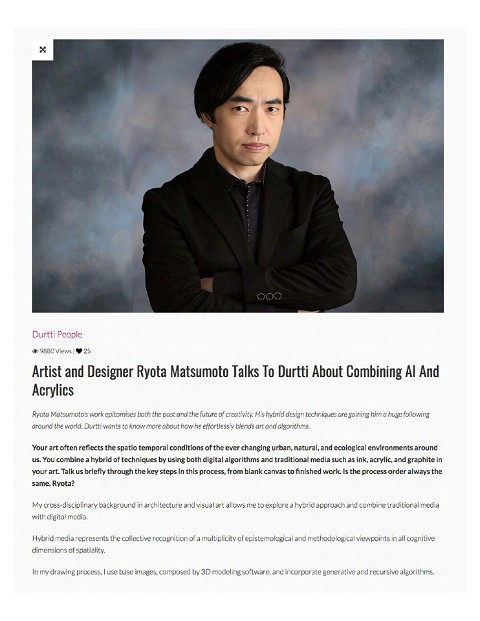
松本良多は東京出身のニューヨークを拠点として活動するアーティスト、建築デザイナー、アーバンプランナー、教育者。
10代を香港とマンハッタンで過ごした後、ロンドンのAAスクール、グラスゴー美術大学、マイアミ大学にて建築と哲学を学び、2007年ペンシルベニア大学大学院芸術学部建築学科を首席で卒業する。マニュエル・デランダ、ヴィンセント・ジョゼフ・スカーリー、セシル・バルモンド、 ジャンカルロ・デ・カルロに師事する。
90年代よりMITメディアラボ、磯崎新、黒川紀章、インダストリアル・ミュージックの先駆者、ピーター・クリストファーソンと協働し、ベトナムバクマイ病院、九州大学センター地区のマスタープランをはじめ多数の建築、都市計画、アートのプロジェクトを手掛ける。ポーランドのシレジア大学の講師を経て、2016年よりプリマス大学 Transart Instituteの客員教授に就任、クーパー・ユニオン、プラット・インスティテュート、コーネル大学、ニューセンター・オブ・リサーチ・アンド・プラクティス シアトル校にてゲストレクチャラーとして教鞭をとっている。シカゴ市文化庁客員キュレーター、英国美術協会 (British Art Network) 名誉会員。
オスロ国立美術大学、カリフォルニア大学アーバイン校、テネリフェ市立美術館にて加速主義、ポストヒューマニズムについて講演している。2017年にはレバーヒューム・トラスト国際学会の招聘によりコーネル大学にて「ポストヒューマニズムと未来都市」について講演する。2019年にはロンドンICAにて「トランスヒューマン社会と生成の唯物論」のレクチャーをキュレート、2020年以降はロージ・ブライドッティとのクリティカル・ヒューマニズムについての講義、エドワード・カックとのカリフォルニア大学アーバイン校でのワークショップと多岐な分野で活動している。
ハイブリッド・アートとアルゴリズミック・コンピュテーションの手法を応用したメディア・アートの作品のインターナショナルな評価によりFILE(Electronic Language International Festival)Prix Lux Finalist、英国 Visual Art Open International Artist Awardを受賞する。
2016年には日本人として初めてイタリアとスペインからPremio Ora賞を同時に受けて2015年、2016年、2017年にロサンゼルスのLos Angeles Center for Digital Art、BYTE Gallery トランスベニア大学、ArtSpace ペスカラにて個展を開催する。2018年、韓国国立中央博物館の招聘展、テキサス大学、 ロサンゼルス現代美術館の常設展示作品のアーティストに選ばれている。

関連スライド

各ページのテキスト
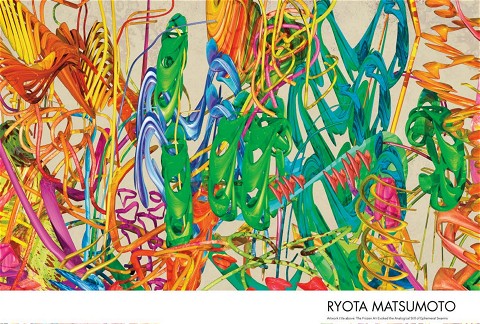
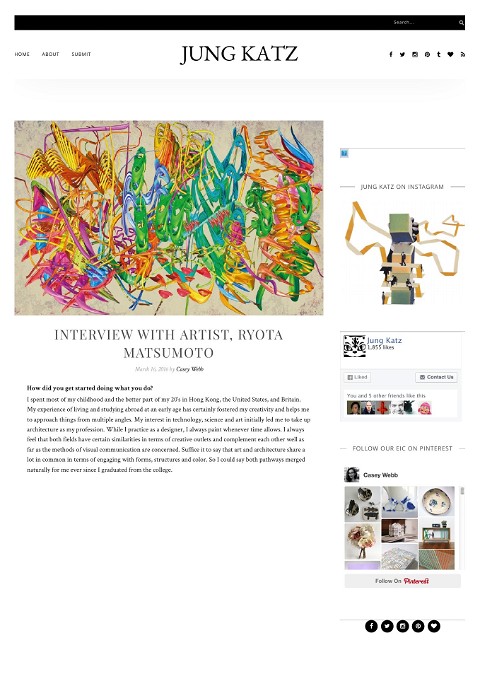
ABOUT ADVERTISE WORK WITH US CONTACT US MADE IN MIND MAGAZINE CURRENT ISSUE BACK ISSUES INTERVIEWS CONTAINERS FOCUS RYOTA MATSUMOTO TRANSLATE: Select Language SEARCH to search type and hit enter READ US ON GOOGLE PLAY REQUEST A PAPER EDITION MADE IN MIND MAGAZINE FOCUS THE REVOLUTION IS US OTTOBRE 6, 2019 HOW TO LIVE IN INTERESTING TIMES GIUGNO 17, 2019 AN OVERVIEW ON MANIFESTA SETTEMBRE 17, 2018 MIART 2018 ACCORDING TO ARTISTS GIUGNO 4, 2018 Artefiera 2018: Winners&Winners FEBBRAIO 6, 2018 Ryota Matsumoto is an artist, designer and urban planner. Born in 1972, Ryota was raised in Hong Kong and Japan. He received Master of Architecture from University of Pennsylvania in 2007 after studying at Architectural Association in London and Mackintosh School of Architecture, Glasgow School of Art in early 90's. His art and built work are featured in numerous publications and exhibitions internationally. His current interest gravitates around the embodiment of cultural possibilities in art, architecture, and urban topography. The artworks of Ryota Matsumoto develop and demonstrate the hybrid/multi layered process, where varying scale, juxtaposition of different forms, intertwined textures/tones are applied to reflect the spatio-temporal conditions of our ever evolving urban and ecological environments. They are created to act as the catalyst for defining speculative changes in our notions of cities, socities and cultures. http://ryotamatsumotostudio.blogspot.it/ Every thought emits the ghost of A gesture Mixed Media 118 x 73 cm - 46 x 29 inches 2014 Can you tell us about your background and artistic path? I was born in Tokyo and spent the better part of 70s living in Hong Kong. I received a Master of Architecture from the University of Pennsylvania in 2007 after studying at the Architectural Association in London and the Mackintosh School of Architecture, Glasgow School of Art in 90's. During my undergraduate study, I acquired basic drawing skills, especially acrylic, ink and etching. I also took courses on modern art history around the same time. I only got to know about all the digital techniques like gen erative art, 3D visualization and parametric design much later, while at graduate school. Certainly architecture, in particular, has greatly influenced your work as an artist. Which aspects of architecture have been the most important in your artistic research? I am always influenced by the spatio-temporal conditions of our ever evolving urban and built environments. The whole nature of cities can be characterized by dichotomy and contrapuntal relationship among organic and inorganic, structural and amorphous as well as small objects and large structures. These seemingly polar opposite elements could integrate with each other and morph into totally new structures of the spatial and temporal variations in my paintings.
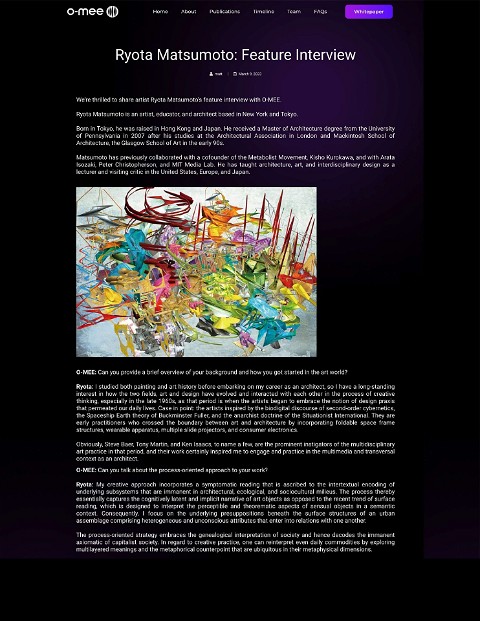
MULTICELLULAR VORTEX FIELD Mixed Media 42 x 59 cm - 17 x 23 inches 2014 Can you tell us of anything else that has influenced your work? I have a penchant for early experimental and electroacoustic music. I am always intrigued by the experimental composers' approach in which the boundaries between electronic and acoustic sounds tend to be blurred. I am especially attracted to this notion of merging and juxtaposing seemingly irreconcilable or contradictory elements. This approach often transcends said boundaries and alters our perception of music in a profound way. I reckon we could apply the same formula to visual art. How would you describe your artistic approach? I explore the hybrid/multi-layered process as my artistic approach, where varying scale, juxtaposition of differentforms, intertwined textures/tones and visual metamorphosis are applied to question the nature of representation in both art and architecture. Can you comment on your painting series and the ideas behind it? How did this project come about? I believe one of the most important aspects of creating art is intuition and the other aspect is one's personal experience and individual background. In my case, my over twenty years' experience in architecture and urban design play the pivotal role in my creative process and inspiration. With most of my work, I am inspired by the relationship of people to architecture in contemporary urban settings and also captured the snapshot of the rapid changes of city scapes with the depiction of various forms in the assembly and disassembly procedures. Tell us a little bit about your process in creating a piece of art; how do you begin working on a piece? My working process tends to be often spontaneous. It is almost improvisational in some way. I sometimes piece together fragments of drawings that I've accumulated over a few weeks. I, myself couldn't predict how things turn out. Therefore, I am less preoccupied with technical and compositional issues in such kind of situation. I also work in more methodical and conventional manner, too. In such cases, the basic lines, curves and multi-dimensional forms are created by algorithmic and generative processes in an early stage. Then they are reconfigured with traditional painting techniques that add layers of colors, textures and details to compositions. What made you choose mixed media as your medium? There is a myriad of possibilities with mixed media and this allows me to take a different and varied approach to every individual artwork. The most interesting aspect of mixed media or so called hybrid drawing technique is that it allows us to achieve variety in both expression and materiality. It is also the best way to discover different materials that don't necessarily belong to my area of specialization. By allowing myself to search for "discordant" unity by bringing various, disparate media together, this experimentation sometimes results in opening up undiscovered territories in my works. At any rate, it is the most appropriate media to explore and achieve multi-dimentional effects on the two-dimentional realm to me. Can you tell about any plans you might have for the future? I have several collaborative projects with a composer, designers and architects in the pipeline. There are also several group exhibitions in both Europe and the States this year. SHARE THIS INTERVIEWS ENRIQUE RAMÍREZ OTTOBRE 6, 2019 THE REVOLUTION IS US OTTOBRE 6, 2019 INTERVIEW WITH GUIDO SANTANDREA OTTOBRE 6, 2019 DAVIDE SGAMBARO OTTOBRE 6, 2019 ANDREA BARBAGALLO... OTTOBRE 6, 2019