Ryota Matsumoto | Made In Mind Autumn 2015
>100 Views
October 24, 23
スライド概要
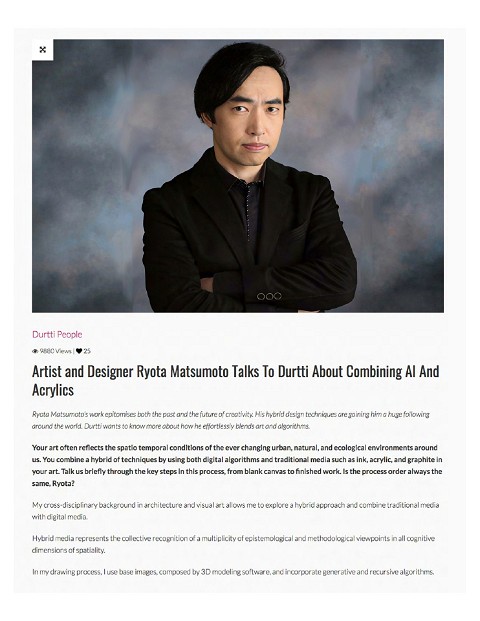
Ryota Matsumoto (松本良多) is an artist, educator, designer, cultural programmer, urban planner, and architect. As a media theorist, he is highly recognized as the iconic pioneer of the postdigital culture.
He has collaborated with a cofounder of the Metabolist Movement, Kisho Kurokawa, and with Arata Isozaki, Peter Christopherson, and MIT Media Lab.
Matsumoto has presented his work on multidisciplinary design, visual culture, and urbanism to the 5th symposium of the Imaginaries of the Future at Cornell University, the Espaciocenter workshop at TEA Tenerife Espacio de las Artes, New Media Frontier Lecture Series at Oslo National Academy of the Arts, UCI Claire Trevor School of the Arts, iDMAa Conference 2017, Network Media Culture Symposium at CCA Kitakyushu, and NTT InterCommunication Center as a literary critic and media theorist. He curated the exhibition, Posthumanism, Epidigital, and Glitch Feminism at Machida City Museum of Graphic Arts in 2020.
As a composer, video producer and graphic designer, he has worked with Peter Christopherson of Coil and Throbbing Gristle for Japanese Nike commercial, his album, Form Grows Rampant, and early sessions of Amulet Edition.
His academic career started as a teaching assistant for Vincent Joseph Scully Jr. and his seminar, the Natural and Manmade in 1993. During his visiting fellowship at the Glasgow School of Art, he has been engaged in research on the process of integrated urban regeneration under the guidance of Giancarlo De Carlo and Isi Metzstein. He continued his pursuit in urban studies and participated in seminal research projects with MIT Media Lab and KieranTimberlake exploring high-rise modular housing, sustainability, and design interventions for Dhaka, Bangladesh in 2005.
Matsumoto has served as the MFA lecturer at Transart Institute, University of Plymouth. He works as a research associate and senior consultant for the New Centre of Research & Practice and the City of Dallas Office of Art and Culture respectively. Matsumoto is an honorary member of the British Art Network. He has been active as a guest critic on design reviews at Cornell University, Cooper Union, Columbia GSAPP, Rhode Island School of Design, and Pratt Institute.
Matsumoto is the recipient of Visual Art Open International Artist Award, Florence Biennale Mixed Media 2nd Place Award, The International Society of Experimental Artists Best of Show Award, Premio Ora Prize Italy 5th Edition, Premio Ora Prize Spain 1st Edition, Donkey Art Prize III Edition Finalist, Best of Show IGOA Toronto, Art Kudos Best of Show Award, FILE (Electronic Language International Festival) Media Art Finalist, Lynx International Prize Award, Lumen Prize Finalist, and Western Bureau Art Prize Honorable Mention.He was awarded the Gold Artist Prize from ArtAscent Journal, the 1st Place Prize from Exhibeo Art Magazine, and the Award of Excellence from the Creative Quarterly Journal of Art and Design in 2015 and 2016. His work is part of the permanent collection of the University of Texas at Tyler.
His work, writings, and interviews were published in Kalubrt Magazine, the University of North Carolina Wilmington Journal Palaver, Furtherfield.org, The Journal of Wild Culture, Studio Visit Magazine, Fresh Paint Magazine, H+ Magazine, International Artist Magazine, Made In Mind Magazine, Arizona State University Journal Superstition Review, Creative Review, Creative Boom, Next Nature Network, Rhizome.org, Monoskop, Carbon Culture Review, KooZA/rch, Supersonic Art, Post Digital Aesthetics (Berry and Dieter ed.), Drawing Discourse (University of North Carolina Asheville), Highlike (SEPI-SP editors), and Drawing Futures (The Bartlett UCL), among others.
Matsumoto’s multidisciplinary projects have been exhibited recently at Meadows Gallery University of Texas at Tyler, S. Tucker Cooke Gallery University of North Carolina Asheville, Sebastopol Center for the Arts, National Museum of Korea, CICA Museum, Van Der Plas Gallery, ArtHelix Gallery, Caelum Gallery, LAIR Gallery Lakehead University, Limner Gallery, the Cello Factory, University of the District of Columbia, Lux Art Gallery, Studio Montclair, Manifest Gallery, Center for Digital Narrative University of Bergen, Tenerife Espacio de las Artes, Art Basel Miami, ISEA International, FILE Sao Paulo, Nook Gallery, and Arts and Heritage Centre Altrincham. He had solo exhibitions at BYTE Gallery Transylvania University (2015), Los Angeles Center of Digital Art (2016), and Alviani ArtSpace, Pescara (2017).

関連スライド

各ページのテキスト
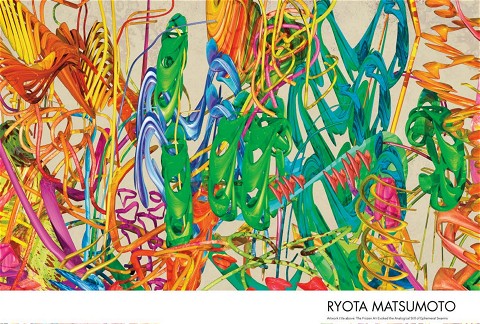
ABOUT ADVERTISE WORK WITH US CONTACT US MADE IN MIND MAGAZINE CURRENT ISSUE BACK ISSUES INTERVIEWS CONTAINERS FOCUS RYOTA MATSUMOTO Ryota Matsumoto is an artist, designer and urban planner. Born in 1972, Ryota was raised in Hong Kong and Japan. He received Master of Architecture from University of Pennsylvania in 2007 after studying at Architectural Association in London and Mackintosh School of Architecture, Glasgow School of Art in early 90's. His art and built work are featured in numerous publications and exhibitions internationally. His current interest gravitates around the embodiment of cultural possibilities in art, architecture, and urban topography. The artworks of Ryota Matsumoto develop and demonstrate the hybrid/multi layered process, where varying scale, juxtaposition of different forms, intertwined textures/tones are applied to reflect the spatio-temporal conditions of our ever evolving urban and ecological environments. They are created to act as the catalyst for defining speculative changes in our notions of cities, socities and cultures. http://ryotamatsumotostudio.blogspot.it/ Every thought emits the ghost of A gesture Mixed Media 118 x 73 cm - 46 x 29 inches 2014 Can you tell us about your background and artistic path? I was born in Tokyo and spent the better part of 70s living in Hong Kong. I received a Master of Architecture from the University of Pennsylvania in 2007 after studying at the Architectural Association in London and the Mackintosh School of Architecture, Glasgow School of Art in 90's. During my undergraduate study, I acquired basic drawing skills, especially acrylic, ink and etching. I also took courses on modern art history around the same time. I only got to know about all the digital techniques like gen erative art, 3D visualization and parametric design much later, while at graduate school. Certainly architecture, in particular, has greatly influenced your work as an artist. Which aspects of architecture have been the most important in your artistic research? I am always influenced by the spatio-temporal conditions of our ever evolving urban and built environments. The whole nature of cities can be characterized by dichotomy and contrapuntal relationship among organic and inorganic, structural and amorphous as well as small objects and large structures. These seemingly polar opposite elements could integrate with each other and morph into totally new structures of the spatial and temporal variations in my paintings. TRANSLATE: Select Language SEARCH to search type and hit enter READ US ON GOOGLE PLAY REQUEST A PAPER EDITION MADE IN MIND MAGAZINE FOCUS THE REVOLUTION IS US OTTOBRE 6, 2019 HOW TO LIVE IN INTERESTING TIMES GIUGNO 17, 2019 AN OVERVIEW ON MANIFESTA SETTEMBRE 17, 2018 MIART 2018 ACCORDING TO ARTISTS GIUGNO 4, 2018 Artefiera 2018: Winners&Winners FEBBRAIO 6, 2018
MULTICELLULAR VORTEX FIELD Mixed Media 42 x 59 cm - 17 x 23 inches 2014 Can you tell us of anything else that has influenced your work? I have a penchant for early experimental and electroacoustic music. I am always intrigued by the experimental composers' approach in which the boundaries between electronic and acoustic sounds tend to be blurred. I am especially attracted to this notion of merging and juxtaposing seemingly irreconcilable or contradictory elements. This approach often transcends said boundaries and alters our perception of music in a profound way. I reckon we could apply the same formula to visual art. How would you describe your artistic approach? I explore the hybrid/multi-layered process as my artistic approach, where varying scale, juxtaposition of differentforms, intertwined textures/tones and visual metamorphosis are applied to question the nature of representation in both art and architecture. Can you comment on your painting series and the ideas behind it? How did this project come about? I believe one of the most important aspects of creating art is intuition and the other aspect is one's personal experience and individual background. In my case, my over twenty years' experience in architecture and urban design play the pivotal role in my creative process and inspiration. With most of my work, I am inspired by the relationship of people to architecture in contemporary urban settings and also captured the snapshot of the rapid changes of city scapes with the depiction of various forms in the assembly and disassembly procedures. Tell us a little bit about your process in creating a piece of art; how do you begin working on a piece? My working process tends to be often spontaneous. It is almost improvisational in some way. I sometimes piece together fragments of drawings that I've accumulated over a few weeks. I, myself couldn't predict how things turn out. Therefore, I am less preoccupied with technical and compositional issues in such kind of situation. I also work in more methodical and conventional manner, too. In such cases, the basic lines, curves and multi-dimensional forms are created by algorithmic and generative processes in an early stage. Then they are reconfigured with traditional painting techniques that add layers of colors, textures and details to compositions. What made you choose mixed media as your medium? There is a myriad of possibilities with mixed media and this allows me to take a different and varied approach to every individual artwork. The most interesting aspect of mixed media or so called hybrid drawing technique is that it allows us to achieve variety in both expression and materiality. It is also the best way to discover different materials that don't necessarily belong to my area of specialization. By allowing myself to search for "discordant" unity by bringing various, disparate media together, this experimentation sometimes results in opening up undiscovered territories in my works. At any rate, it is the most appropriate media to explore and achieve multi-dimentional effects on the two-dimentional realm to me. Can you tell about any plans you might have for the future? I have several collaborative projects with a composer, designers and architects in the pipeline. There are also several group exhibitions in both Europe and the States this year. SHARE THIS INTERVIEWS ENRIQUE RAMÍREZ OTTOBRE 6, 2019 THE REVOLUTION IS US OTTOBRE 6, 2019 INTERVIEW WITH GUIDO SANTANDREA OTTOBRE 6, 2019 DAVIDE SGAMBARO OTTOBRE 6, 2019 ANDREA BARBAGALLO... OTTOBRE 6, 2019