Ryota Matsumoto M Fashon & Art Magazine September 2016
>100 Views
October 24, 23
スライド概要
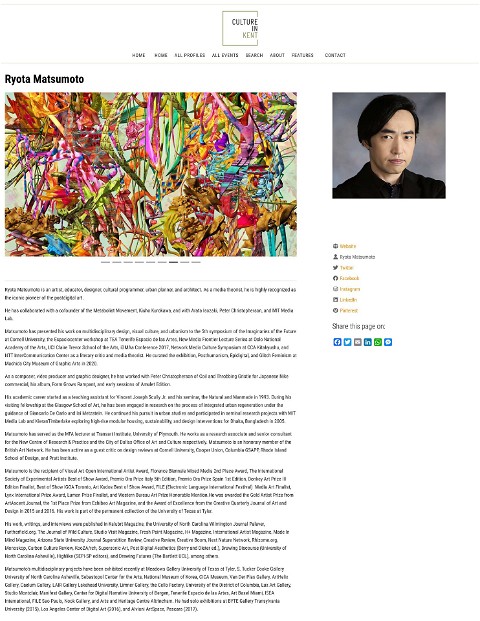
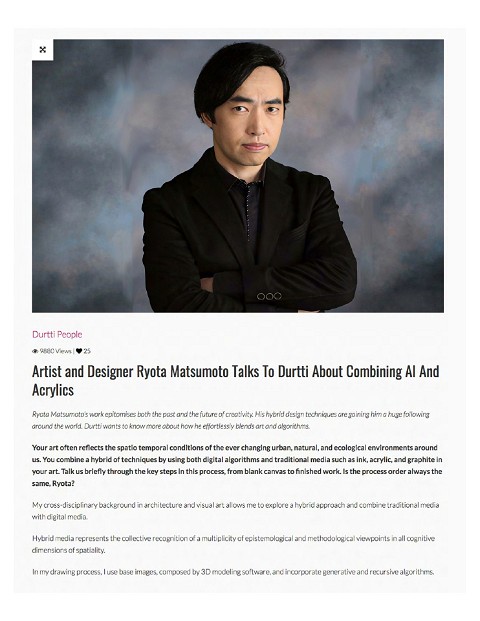
Ryota Matsumoto (松本良多) is an artist, educator, designer, cultural programmer, urban planner, and architect. As a media theorist, he is highly recognized as the iconic pioneer of the postdigital culture.
He has collaborated with a cofounder of the Metabolist Movement, Kisho Kurokawa, and with Arata Isozaki, Peter Christopherson, and MIT Media Lab.
Matsumoto has presented his work on multidisciplinary design, visual culture, and urbanism to the 5th symposium of the Imaginaries of the Future at Cornell University, the Espaciocenter workshop at TEA Tenerife Espacio de las Artes, New Media Frontier Lecture Series at Oslo National Academy of the Arts, UCI Claire Trevor School of the Arts, iDMAa Conference 2017, Network Media Culture Symposium at CCA Kitakyushu, and NTT InterCommunication Center as a literary critic and media theorist. He curated the exhibition, Posthumanism, Epidigital, and Glitch Feminism at Machida City Museum of Graphic Arts in 2020.
As a composer, video producer and graphic designer, he has worked with Peter Christopherson of Coil and Throbbing Gristle for Japanese Nike commercial, his album, Form Grows Rampant, and early sessions of Amulet Edition.
His academic career started as a teaching assistant for Vincent Joseph Scully Jr. and his seminar, the Natural and Manmade in 1993. During his visiting fellowship at the Glasgow School of Art, he has been engaged in research on the process of integrated urban regeneration under the guidance of Giancarlo De Carlo and Isi Metzstein. He continued his pursuit in urban studies and participated in seminal research projects with MIT Media Lab and KieranTimberlake exploring high-rise modular housing, sustainability, and design interventions for Dhaka, Bangladesh in 2005.
Matsumoto has served as the MFA lecturer at Transart Institute, University of Plymouth. He works as a research associate and senior consultant for the New Centre of Research & Practice and the City of Dallas Office of Art and Culture respectively. Matsumoto is an honorary member of the British Art Network. He has been active as a guest critic on design reviews at Cornell University, Cooper Union, Columbia GSAPP, Rhode Island School of Design, and Pratt Institute.
Matsumoto is the recipient of Visual Art Open International Artist Award, Florence Biennale Mixed Media 2nd Place Award, The International Society of Experimental Artists Best of Show Award, Premio Ora Prize Italy 5th Edition, Premio Ora Prize Spain 1st Edition, Donkey Art Prize III Edition Finalist, Best of Show IGOA Toronto, Art Kudos Best of Show Award, FILE (Electronic Language International Festival) Media Art Finalist, Lynx International Prize Award, Lumen Prize Finalist, and Western Bureau Art Prize Honorable Mention.He was awarded the Gold Artist Prize from ArtAscent Journal, the 1st Place Prize from Exhibeo Art Magazine, and the Award of Excellence from the Creative Quarterly Journal of Art and Design in 2015 and 2016. His work is part of the permanent collection of the University of Texas at Tyler.
His work, writings, and interviews were published in Kalubrt Magazine, the University of North Carolina Wilmington Journal Palaver, Furtherfield.org, The Journal of Wild Culture, Studio Visit Magazine, Fresh Paint Magazine, H+ Magazine, International Artist Magazine, Made In Mind Magazine, Arizona State University Journal Superstition Review, Creative Review, Creative Boom, Next Nature Network, Rhizome.org, Monoskop, Carbon Culture Review, KooZA/rch, Supersonic Art, Post Digital Aesthetics (Berry and Dieter ed.), Drawing Discourse (University of North Carolina Asheville), Highlike (SEPI-SP editors), and Drawing Futures (The Bartlett UCL), among others.
Matsumoto’s multidisciplinary projects have been exhibited recently at Meadows Gallery University of Texas at Tyler, S. Tucker Cooke Gallery University of North Carolina Asheville, Sebastopol Center for the Arts, National Museum of Korea, CICA Museum, Van Der Plas Gallery, ArtHelix Gallery, Caelum Gallery, LAIR Gallery Lakehead University, Limner Gallery, the Cello Factory, University of the District of Columbia, Lux Art Gallery, Studio Montclair, Manifest Gallery, Center for Digital Narrative University of Bergen, Tenerife Espacio de las Artes, Art Basel Miami, ISEA International, FILE Sao Paulo, Nook Gallery, and Arts and Heritage Centre Altrincham. He had solo exhibitions at BYTE Gallery Transylvania University (2015), Los Angeles Center of Digital Art (2016), and Alviani ArtSpace, Pescara (2017).

関連スライド

各ページのテキスト
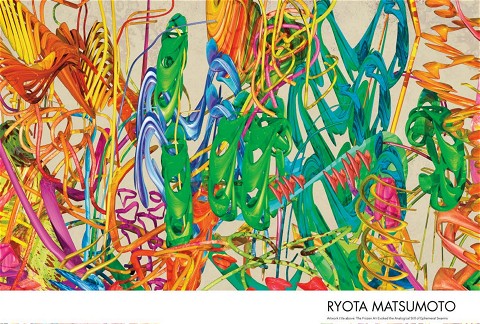
RYOTA MATSUMOTO Artwork title above: The Frozen Air Evoked the Analogical Still of Ephemeral Swarms
Tell us a little about yourself. Interview with Ryota Matsumoto I am a founder and principal of the interdisciplinary design studio based in Tokyo and work as both designer, urban planner and artist. I was born in Japan and had spent most of my childhood and the better part of my 20's and early 30's in Hong Kong, the United States and Britain. My experience of living and studying abroad at an early age has certainly fostered my creativity and helps me to approach things from multiple angles. I studied architecture and art history as my undergraduate studies at Architectural Association in London and Glasgow School of Art in early 90's. I probably belong to the last generation working with ink and pencil drafting for thesis projects as it was a few years before the real advancement of Cad technology. Eventually, I received a Master of Architecture degree from University of Pennsylvania in 2007 after nearly ten years of professional practice. That is when I learned all the 3d digital design and parametric modeling techniques formally for the first time. As I started out my career as an architect, I had collaborated with the associate of the Metabolist movement in 60s, Kisho Kurokawa as a senior designer of Nihon Sekkei Inc. and took on large urban planning projects and campus master plan. All of these life experiences and influences eventually come together somehow and culminate in my exploration of the visual works later on. Artwork title above: Rapid Gaze Polynomials Embedded in Infinite Variables What inspired you to become an artist, and the style of art you create? My interest in technology, science and art initially led me to take up architecture as my profession initially. While I practice as a designer, I always paint whenever time allows. I always feel that both fields have certain similarities in terms of creative outlets and complement each other as well as for a multiperspective approach to visual communication is concerned. Suffice to say that art and architecture share a lot in common in terms of engaging with forms, structures and color. So I could say both pathways merged naturally for me ever since I graduated from the college. It seems to me the boundaries between art and design disciplines are no longer of any significance and they tend to blur nowadays. I think the emergence of Bio design, postdigital hybrid media and ecopolitical reality of the Anthropocene epoch inspire my creative process to a considerable degree and motivate me to depict the urban and ecological milieus of conjectural future informed by the complex interplay of socioeconomic, institutional and technological activities. What advice could you give to someone who aspired to become an artist and be successful in this competitive field? I am not certain if it is related to success in general sense. However, looking back now, I live by the certain principles from my early career. At first glance it might sound like a career detour, however, it is always helpful to go off the beaten path before starting out as an artist. In my case, my experience as an architectural designer and urban planner certainly helped me to break the mold and approach my work with a broader perspective. Even now, I still firmly believe that it is always helpful to learn and acquire the wider knowledge and skills from other fields and opening up your mind to new ideas would allow you to discover your own creative path. If you could be anywhere in the world right now, where would you go? I like to travel a lot, discovering a new place and to meet people from a different cultural and professional background, whenever time allows. I never have chance to settle down and live a life of constant travel since my childhood. So, for this lifestyle proves to be a great learning experience. Therefore, I go wherever my work and feet take me right now and a next destination for my projects or workshops naturally turns out be a place I would like to go. Artwork detail at right : The Frozen Air Evoked the Analogical Still of Ephemeral Swarms
How do you keep your pieces fresh? I don't plan much beforehand and might do some sketches, but they usually turn into something drastically different or unrecognizable in due course. I prefer to take an unexpected trip that might lead me down an unpredictable path. Spontaneity is a crucial element to keep the tension and freshness in my work, especially when I work with digital media, which is often associated with formalistic rigidity. You have one many awards and received recognition around the world. What is your greatest accomplishment? To be honest, I would say my greatest accomplishment I am most proud of thus far has been finishing the college and receiving my diploma. I'd admit I wasn't a bright student by any stretch of the imagination. Tell us a little more about how you combine traditional media and digital media in your work? My drawing process involves base images that are composed by 3D modeling software incorporating generative and recursive algorithms. Then they are overlaid with traditional media such as acrylic, ink and graphite, as well as scanned found images. These are further processed and looped through a series of arithmetic and stochastic operations by image editing programs and plugins. The hybrid technique allows for a certain degree of unpredictability of visual dynamics. At the same time, painterly, organic sentiments of traditional media reveal themselves amidst the otherwise detached precision of digital drawings. How did your education in architecture, pave the way to your artistry? As far as my architectural education is concerned, we were trained to work as a bridging point among various disciplines. From our formative years, we learned to pick things up quickly from different fields and apply them to resolve any issues in our design projects. In that respect, interdisciplinary thinking comes naturally to me and I guess that kind of a critical mindset is indispensable for the development of one's artistry. If you ever have a writer's block, or in your case an artist's block, how do you fix it? I firmly believe that creativity comes out of a whirlpool of chaos. So what I always do is jotting down or drawing whatever pops into my head. Then I create associations among random words, diagrams or drawings from my sketchbooks. It is probably similar to surrealists' cadavre exquis in terms of a creative process. It allows you to take up any mundane ideas and to turn them into something inventive and innovative. This might help us from getting bogged down by same-niche inspiration and idea. What is one word (or phrase) you would use to describe yourself? Maybe, wanderer or drifter could be one word that I'd associate with myself, as I never feel like belonging to a specific cultural background, because of my multinational upbringing and it seems to continue in this way to this day. Better yet, the word also connotes someone who is on an endless journey to find the eternal truth and that is something I like about it. Artwork title below: The Biometric Ephemera of Positronic Variation within Transient Bounds