Artist Ryota Matsumoto Landscape Art Review November 2014
>100 Views
October 24, 23
スライド概要
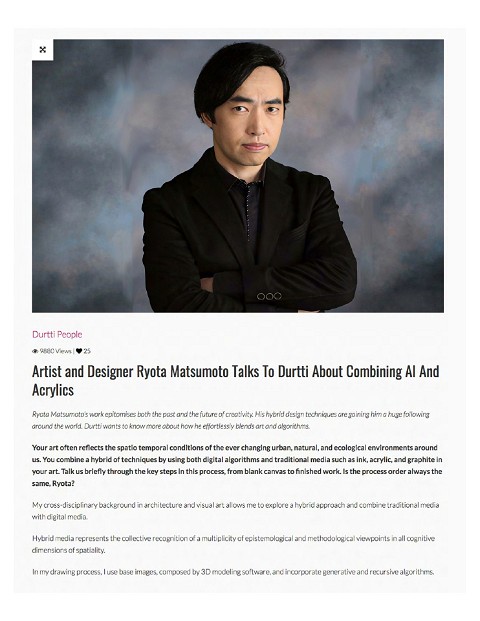
Ryota Matsumoto (松本良多) is an artist, educator, designer, cultural programmer, urban planner, and architect. As a media theorist, he is highly recognized as the iconic pioneer of the postdigital culture.
He has collaborated with a cofounder of the Metabolist Movement, Kisho Kurokawa, and with Arata Isozaki, Peter Christopherson, and MIT Media Lab.
Matsumoto has presented his work on multidisciplinary design, visual culture, and urbanism to the 5th symposium of the Imaginaries of the Future at Cornell University, the Espaciocenter workshop at TEA Tenerife Espacio de las Artes, New Media Frontier Lecture Series at Oslo National Academy of the Arts, UCI Claire Trevor School of the Arts, iDMAa Conference 2017, Network Media Culture Symposium at CCA Kitakyushu, and NTT InterCommunication Center as a literary critic and media theorist. He curated the exhibition, Posthumanism, Epidigital, and Glitch Feminism at Machida City Museum of Graphic Arts in 2020.
As a composer, video producer and graphic designer, he has worked with Peter Christopherson of Coil and Throbbing Gristle for Japanese Nike commercial, his album, Form Grows Rampant, and early sessions of Amulet Edition.
His academic career started as a teaching assistant for Vincent Joseph Scully Jr. and his seminar, the Natural and Manmade in 1993. During his visiting fellowship at the Glasgow School of Art, he has been engaged in research on the process of integrated urban regeneration under the guidance of Giancarlo De Carlo and Isi Metzstein. He continued his pursuit in urban studies and participated in seminal research projects with MIT Media Lab and KieranTimberlake exploring high-rise modular housing, sustainability, and design interventions for Dhaka, Bangladesh in 2005.
Matsumoto has served as the MFA lecturer at Transart Institute, University of Plymouth. He works as a research associate and senior consultant for the New Centre of Research & Practice and the City of Dallas Office of Art and Culture respectively. Matsumoto is an honorary member of the British Art Network. He has been active as a guest critic on design reviews at Cornell University, Cooper Union, Columbia GSAPP, Rhode Island School of Design, and Pratt Institute.
Matsumoto is the recipient of Visual Art Open International Artist Award, Florence Biennale Mixed Media 2nd Place Award, The International Society of Experimental Artists Best of Show Award, Premio Ora Prize Italy 5th Edition, Premio Ora Prize Spain 1st Edition, Donkey Art Prize III Edition Finalist, Best of Show IGOA Toronto, Art Kudos Best of Show Award, FILE (Electronic Language International Festival) Media Art Finalist, Lynx International Prize Award, Lumen Prize Finalist, and Western Bureau Art Prize Honorable Mention.He was awarded the Gold Artist Prize from ArtAscent Journal, the 1st Place Prize from Exhibeo Art Magazine, and the Award of Excellence from the Creative Quarterly Journal of Art and Design in 2015 and 2016. His work is part of the permanent collection of the University of Texas at Tyler.
His work, writings, and interviews were published in Kalubrt Magazine, the University of North Carolina Wilmington Journal Palaver, Furtherfield.org, The Journal of Wild Culture, Studio Visit Magazine, Fresh Paint Magazine, H+ Magazine, International Artist Magazine, Made In Mind Magazine, Arizona State University Journal Superstition Review, Creative Review, Creative Boom, Next Nature Network, Rhizome.org, Monoskop, Carbon Culture Review, KooZA/rch, Supersonic Art, Post Digital Aesthetics (Berry and Dieter ed.), Drawing Discourse (University of North Carolina Asheville), Highlike (SEPI-SP editors), and Drawing Futures (The Bartlett UCL), among others.
Matsumoto’s multidisciplinary projects have been exhibited recently at Meadows Gallery University of Texas at Tyler, S. Tucker Cooke Gallery University of North Carolina Asheville, Sebastopol Center for the Arts, National Museum of Korea, CICA Museum, Van Der Plas Gallery, ArtHelix Gallery, Caelum Gallery, LAIR Gallery Lakehead University, Limner Gallery, the Cello Factory, University of the District of Columbia, Lux Art Gallery, Studio Montclair, Manifest Gallery, Center for Digital Narrative University of Bergen, Tenerife Espacio de las Artes, Art Basel Miami, ISEA International, FILE Sao Paulo, Nook Gallery, and Arts and Heritage Centre Altrincham. He had solo exhibitions at BYTE Gallery Transylvania University (2015), Los Angeles Center of Digital Art (2016), and Alviani ArtSpace, Pescara (2017).

関連スライド

各ページのテキスト
Land Escape CONTEMPORARY ART REVIEW Ryota Matsumoto Lives and works in Tokyo and New York City An artist's statement Matsumoto's artwork reflects the morphological transformations of our ever-evolving urban and ecological milieus that are attributed to a multitude of spatio-temporal phenomena influenced by social, economic and cultural factors. The artwork explores the hybrid technique combining both traditional media (ink, acrylic, graphite and photo collage) and digital media (algorithmic processing, parametric modeling, data transcoding and image compositing with custom software). The varying scale, juxtaposition of biomorphic forms, intertwined textures, oblique projections and visual metamorphoses are employed as the multi-layered drawing methodologies to question and investigate the ubiquitous nature of urban meta-morphology, the eco-political reality of the Anthropocene epoch, the advancement of biomaterial technologies and their visual representation in the context of non-Euclidean configuration. Furthermore, the application of these techniques allow the work to transcend the boundaries between analog and digital media as well as between two- and multi-dimensional domains. His compositional techniques imbue the work with what we see as the very essence of our socio-cultural environments beyond the conventional protocols of architectural and artistic formalities, and that they conjure up the synthetic possibilities within which the spatial and temporal variations of existing spatial semiotics emerge as the potential products of alchemical procedures. Ryota Matsumoto is a principal and founder of an award-winning interdisciplinary design office, Ryota Matsumoto Studio. He is an artist, designer and urban planner. Born in Tokyo, he was raised in Hong Kong and Japan. Ryota Matsumoto He received a Master of Architecture degree from University of Pennsylvania in 2007 after his studies at Architectural Association in London and Mackintosh School of Architecture, Glasgow School of Art in early 90's. Matsumoto has previously collaborated with a cofounder of the Metabolist Movement, Kisho Kurokawa, Arata Isozaki, Cesar Pelli, MIT Media Lab and Nihon Sekkei Inc. before establishing his office. His current interest gravitates around the embodiment of cultural possibilities in art, ecology and urban topography. 22
Land Escape CONTEMPORARY ART REVIEW LandEscape meets Ryota Matsumoto An interview by Katherine Williams, curator and Josh Ryder, curator [email protected] Ryota Matsumoto is an artist who bravely transverses borders: his work provides the spectators with an augmented experience, forcing the channel of communication between between perception and imagination, to challenge the relationship between the viewers' perceptual parameters and their cultural substratum. His works induce us to elaborate personal associations, offering at the same time a captivating multilayered aesthetic experience. One of the most impressive aspects of Matsumoto's work is the way it accomplishes the difficult task of showing the elusive point of convergence between two- and multi-dimensional domains. We are very pleased to introduce our readers to his stimulating and multifaceted artistic production. Hello Ryota and welcome to LandEscape: before starting to Ryota Matsumoto elaborate about your artistic production would you like to tell us something about your background? You have a solid formal training and you hold a Master of Architecture degree, that you received from the University of Pennsylvania after your studies at Architectural Association in 24
Land Escape CONTEMPORARY ART REVIEW 25
Land Escape CONTEMPORARY ART REVIEW Ryota Matsumoto 30
Ryota Matsumoto Land Escape CONTEMPORARY ART REVIEW London and Mackintosh School of Architecture, Glasgow School of Art in early: how do these experiences influence the way you conceive your artworks? And in particular, how does your cultural substratum inform the way you relate yourself to art making and to the aesthetic problem in general? As architecture relates to other creative fields such as art, technology, and the study of cultures, it was crucial for me to have interests in a broad range of subjects even during my formative years as a designer. For example, I like to paint whenever time allows. Therefore, I feel that the academic fields listed above have certain similarities in terms of being creative outlets, and complement each other well as far as a multi-perspective approach to visual communication is concerned. Suffice to say, art and architecture share a lot in common in terms of engaging with forms, structures, and color. For me, both pathways merged naturally after I graduated from college. At the present time, it seems to me that the boundaries between art and design disciplines are increasingly less significant, since they tend to blur. There are emerging cross-disciplinary and intercultural practices that seek to address impending issues of trans- 31
Land Escape CONTEMPORARY ART REVIEW Ryota Matsumoto human epistemology and the Anthropocene epoch. These agendas led me to speculate on future urban and ecological milieus that would be informed by the complex interplay of socio-economic, institutional, and technological activities. Your approach is very personal and condenses a variety of technique including watercolor, acrylic and latex paint, colored pencils, graphite, and gold leaf, that you combine together into a coherent balance. We would like to direct to our readers to your website www.ryotamatsumoto.com in order to get a synoptic view of your work: while walking our readers through your process, we would like to ask you if you have ever happened to realize that such combination between different media is the only way to express and convey the idea you explore. I think there are still a myriad of ways to test ideas and experiment with a multitude of media platforms. For instance, my work could be integrated with cloud computing, online communities, digital fabrication, and mobile devices. Consequently, my work is perceived as something that is constantly in flux, and transforms 32
Ryota Matsumoto Land Escape CONTEMPORARY ART REVIEW 33
Land Escape CONTEMPORARY ART REVIEW Ryota Matsumoto relative to ever-changing socio-cultural dynamics. Would you tell our readers something about your usual process and the evolution of your style? In particular, are your works painted gesturally, instinctively? Or do you methodically transpose geometric schemes from paper to canvas? 34
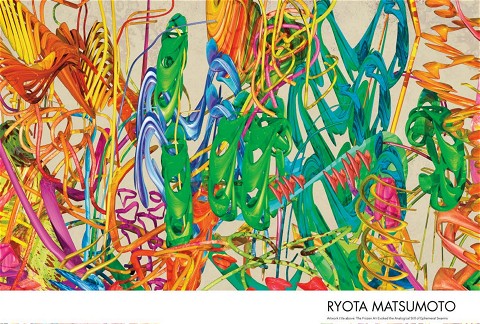
Ryota Matsumoto Land Escape CONTEMPORARY ART REVIEW My drawing process involves base images that are composed by 3D modeling software incorporating generative and recursive algorithms. Some of my works employ a multi- agent system designed for Swarm Intelligence as a draft guideline for finished work. Then these drawings are overlaid with traditional media such as acrylic, ink and graphite, or 35
Land Escape CONTEMPORARY ART REVIEW Ryota Matsumoto photo collage. Finally, these compositions are further processed and looped through a series of arithmetic and stochastic operations or agent-based algorithms through the use of custom image editing programs. For this special edition of LandEscape we have selected Oblique Trail Convolution and Surviving in the 36
Ryota Matsumoto Land Escape CONTEMPORARY ART REVIEW 37
Land Escape CONTEMPORARY ART REVIEW Ryota Matsumoto 38
Ryota Matsumoto Land Escape CONTEMPORARY ART REVIEW Multidimensional Space of Cognitive Dissonance, a couple of interesting works that our readers have already started to admire in the introductory pages of this article. What has at once captured our attention of your captivating investigation about the relationship between your painting and the actual places you painted is the way you provided the visual results of your analysis with autonomous aesthetics: while walking our readers through the genesis of Oblique Trail Convolution and Surviving in the Multidimensional Space of Cognitive Dissonance, would you shed light to your main sources of inspiration? Both works explore the symbiotic interplay of advanced biosynthetic technologies and preexisting obsolete infrastructures, in a search for an alternative trajectory of future environmental possibilities. In short, new technologies can complement old ones instead of completely replacing them, to avoid starting over from a blank slate or facing further ecological catastrophes. I also propose a speculative construct that goes beyond object-oriented ontology, as self-generating synthetic biological actors and technological relics of human interventions can co- exist and act as the catalyst to facilitate the post-human geological epoch. Your works allow an open reading, a great multiplicity of meanings to associative possibilities in the viewes, that seem to play a crucial role in your pieces. How important is this degree of openness? Most of my drawings are not confined to any particular time, location, or historical setting. Even though these works weave together certain narrative elements and recurring underlying themes, they are still relatively open-ended and non-contextual in nature. In short, anyone could interpret my work and create a fictional backdrop through their own interpretation. For instance, the titles of the work don't necessarily correlate with their themes, which can evoke further imagination for the viewer. When showing clear references to perceptual reality, your works convey a captivating abstract feeling that provide with dynamism the representative feature of your canvass, as Transient Field in the Air. The way you to capture non-sharpness with an universal kind of language quality marks out a considerable part of your production, 39
Land Escape CONTEMPORARY ART REVIEW Ryota Matsumoto that are in a certain sense representative of the relationship between emotion and memory. How would you define the relationship between abstraction and representation in your practice? In particular, how does representation and a tendency towards abstraction find their balance in your work? As Eric Kandel explained in Reductionism in Art and Brain Science, our cognitive processing systems tend to become overloaded, such that we have to filter out abundant information to perceive images. That kind of reductionist tendency could be defined as abstraction. So should the cave paintings at Lascaux and Altamira be considered abstract art or figurative work? If you take Bataille's theory on the birth of art into account, it is hard to draw a line between abstraction and representation. The multi-layered drawing methodologies you adopt in your works draw the viewer to challenge their perceptual categories: the spectator plays a very active role in determing meaning for your images. How do you view the concepts of the real and the imagined playing out within your works? 40
Ryota Matsumoto Land Escape CONTEMPORARY ART REVIEW 41
Land Escape CONTEMPORARY ART REVIEW Ryota Matsumoto 42
Ryota Matsumoto Land Escape CONTEMPORARY ART REVIEW The neuroscience researchers have demonstrated that the brain can't actually distinguish between the real, the imaginary or even dream at its subconscious level. The multi-layered approach is the way to create another dimension to a space-time substrate and it is meant to enhance the viewer's neural pathways of thought and memory. My creative goal is to alter visual perceptions of space for the viewer, as the systematic correlation of viewer and viewed is not something explicitly expressed and explored in visual perception in the course of our usual engagement with the world. While marked out with a deep introspective quality, your pieces are more than mere representations of your inner self: you rather seem to invite the viewers to an augmented perceptual experience to discover unexpected aspects not only of their inner world, but of the connectivity that affects our everchanging contemporary age. Your works and in particular The Celestial Map of Dream Sequences how create an immersive experience capable of generating both psichological and physical involvement. How would you consider the relationship between the inner landscape and the outside 43
Land Escape CONTEMPORARY ART REVIEW Ryota Matsumoto world? Could art provide us with a channel of communication between these aspects of reality? Our lives are intimately interwoven with the web of planetary-scale computational platforms and networks, blurring the boundaries between real and virtual worlds. The increasing interpenetration of virtual and physical realms are apparent; the same can be said about my work. Your hybrid technique inquires into the liminal area in ink, acrylic, graphite and photo collage and digital media find a consitent point of convergence, challenginf an inner cultural debate between traditional heritage and contemporariness: despite the reminders to traditional figurative approach, your works is marked out with a stimulating contemporary sensitiveness. Do you think that there's still a contrast between Tradition and Contempoariness? Or there's an interstitial area where these apparently opposite elements could produce a proficient synergy? The Situationists and visionary architects in 1960's utilized a wide range of media to communicate visually and express their collective vision of unitary urbanism. Their work has inspired me to a great extent, and allowing me to incorporate digital 42
Ryota Matsumoto Land Escape CONTEMPORARY ART REVIEW media that open up further possibilities in terms of spatial visualization. This technique allows for a certain degree of unpredictability in visual dynamics. At the same time, painterly and organic sentiments of traditional media reveal 43
Land Escape CONTEMPORARY ART REVIEW Ryota Matsumoto 42
Ryota Matsumoto Land Escape CONTEMPORARY ART REVIEW themselves amidst the otherwise detached precision of digital drawings. Moreover, hybrid media allows me to take on a broad range of subjects as opposed to more traditional approaches. I am certain there is still untapped potential and uncharted territory to explore by merging traditional and digital media. Your pieces explore visual representation in the context of non-Euclidean configuration: would you say that you are creating materiality of the immaterial? My notion of space isn't necessarily limited to the materiality of gridded topological vector fields based on a Cartesian coordinate system. We need to go beyond constrained-node networks optimized by affordance-based design. Over these years you have exhibited in several occasions, including your upcoming participation to the 32nd Annual International Exhibition at the Meadows Gallery, University of Texas at Tyler. One of the hallmarks of your work is the capability to create direct involvement with the viewers, who are urged to evolve from a condition of mere spectatorship. So before leaving this conversation we would like to pose a question about the nature of the relationship of your art with your audience. Do you consider the issue of audience reception as being a crucial component of your decision-making process, in terms of what type of language is used in a particular context? As Douglas Gordon stated, art is not an object - it operates as a dialogue or communication medium between the artist and viewer. I firmly believe in the participatory, open aspect of visual art practice. Art is bound to be interactive media that engages viewers in conversation. Thanks a lot for your time and for sharing your thoughts, Ryota. Finally, would you like to tell us readers something about your future projects? What are some things you would like to accomplish in the coming years? I will collaborate with artists and theorists in different fields to broaden our creative outlook. I also hope to find more time to teach and talk about my work. Thank you very much. An interview by Katherine Williams, curator and Josh Ryder, curator [email protected] 43